Sustainable Material & Product Selection for Eco-Friendly Interior Design

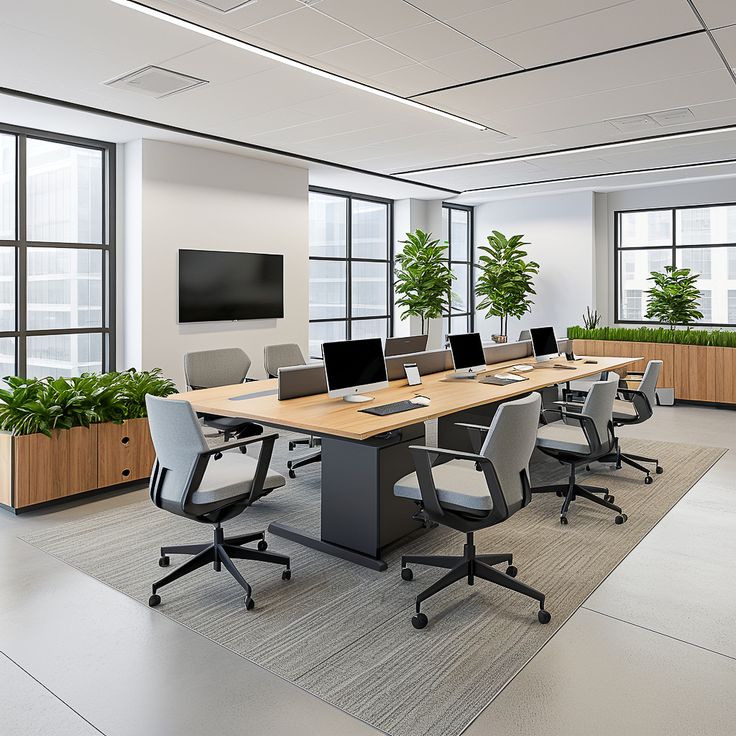
The office is no longer just a place to work. In 2026, it is a living, breathing, data-driven ecosystem — one that adjusts its lighting when you walk in, books meeting rooms before you remember to, and monitors air quality so your team stays sharp at 4 PM. This is the era of smart office interior design, and at E Square Interiors, it is transforming every commercial project we undertake across India.
For business owners, entrepreneurs, and corporate leaders planning a new office or renovation in 2026, understanding how smart technology integrates with interior design is no longer optional — it is a competitive advantage. Offices that implement intelligent systems see measurable gains in employee productivity, energy savings, and real estate efficiency. This guide, built on our decade of commercial interior experience at E Square Interiors, walks you through every major smart technology category shaping the modern workplace.
E Square Interiors’ Promise: Every insight in this guide is drawn from real commercial projects, vendor assessments, and current industry research. We design offices that don’t just look impressive—they perform intelligently from Day 1.
Smart office interior design refers to the seamless integration of intelligent technology — artificial intelligence, Internet of Things (IoT), sensors, and automation — into the physical fabric of a workspace. It is the discipline of designing offices where the environment actively responds to the people inside it, rather than remaining passive and static.
At E Square Interiors, we define a smart office across three interconnected dimensions: how the space looks (aesthetics and design intent), how it feels (comfort, acoustics, air, light), and how it performs (data, energy, efficiency). A truly smart office excels on all three levels simultaneously — not just one.
The key technologies that make a workspace truly “smart” in 2026 include:
India’s corporate landscape has crossed a critical threshold. Hybrid work is now the norm rather than the experiment. Tech costs have fallen dramatically — IoT modules and sensors in 2026 cost a fraction of what they did in 2022, and the ROI on smart office upgrades now typically ranges from 24 to 36 months, making it financially viable even for mid-sized businesses.
Across Indian metros — Mumbai, Bangalore, Hyderabad, Pune, and Delhi NCR — companies are rapidly upgrading their offices not just for aesthetics but for intelligence. Startups want tech-forward spaces that impress investors. Corporates want data-driven workspaces that prove their sustainability ESG commitments. Co-working brands need offices that adapt to fluctuating occupancy daily. E Square Interiors has seen this demand surge firsthand across every segment of our commercial client base.
Lighting is the single most impactful element in any smart office interior design project. In 2026, it is no longer a backdrop — it is an active performance tool. At E Square Interiors, we approach lighting as a science, not just an aesthetic choice. The best corporate offices now use Human-Centric Lighting (HCL) systems that mimic natural sunlight patterns throughout the working day.
HCL systems use cool-toned light (5000K–6500K) in the morning to stimulate alertness and energy — essentially replicating the feel of bright morning sunlight. As the afternoon progresses, the system gradually shifts to warmer amber tones (2700K–3000K), reducing eye strain and supporting the natural melatonin cycle. Research consistently shows that circadian-friendly lighting improves self-reported workplace performance by up to 18%, making it one of the highest-ROI smart office investments available.
Smart lighting systems paired with occupancy sensors automatically switch off in unused meeting rooms, corridors, and focus pods. A 50,000 sq. ft. corporate office that E Square Interiors consulted for reduced its energy costs by 35% simply by adding occupancy-triggered lighting controls to its existing LED infrastructure. No fixture replacement — just intelligence layered on top of existing hardware.
In 2026, the dominant protocol connecting smart lighting devices is Matter — a universal interoperability standard ensuring devices from different brands (Philips Hue, Lutron, Legrand) work seamlessly together without separate hubs. E Square Interiors specifies Matter-compatible systems across all our smart office projects, future-proofing your investment against vendor lock-in.
One of the most valuable and underutilised capabilities in modern smart office interior design is the ability to truly understand how your space is being used — in real time, with granular data. IoT occupancy sensors embedded in task chairs, meeting tables, ceiling mounts, and workstation partitions continuously collect data that transforms guesswork into evidence.
At E Square Interiors, we have seen Indian businesses pay for 80 workstations when only 45 are consistently used. That’s wasted real estate — a significant cost in cities like Mumbai or Bangalore. Smart space analytics platforms surface this data clearly, allowing leadership to right-size layouts, introduce hot-desking for the right zones, and identify underperforming areas that can be repurposed into high-value collaboration spaces.
This data feeds into digital twin technology — virtual replicas of your physical office that allow facility managers and designers to simulate layout changes, visualise occupancy scenarios, and model energy outcomes without moving a single desk. At E Square Interiors, we are increasingly integrating digital twin planning into our commercial design process, giving clients complete confidence before any physical work begins.
Poor air quality and uncomfortable temperatures are among the leading contributors to workplace discomfort and reduced cognitive performance. A smart office interior design in 2026 treats HVAC not as a building services afterthought, but as a core design element planned from the very first layout sketch.
AI-enabled HVAC systems in modern offices do something traditional systems cannot: they predict rather than react. By combining IoT occupancy data with real-time weather APIs and historical usage patterns, smart HVAC systems pre-condition spaces before employees arrive, zone temperature independently by workspace type, and power down entirely in unused areas — all automatically, without any manual intervention.
Noise consistently ranks as the top workplace complaint globally, and in 2026, the most sophisticated smart office interior design addresses acoustics with the same rigour as lighting or HVAC. E Square Interiors now conducts acoustic mapping — using sound level monitoring tools — before finalising any open-plan office layout, ensuring that the design eliminates noise hotspots before construction begins.
AI microphones and ceiling-mounted acoustic arrays can identify zones that generate excessive noise — typically collaboration areas near focus pods — and automatically trigger white noise adjustments or notify facility managers to reconfigure the space. In hybrid meeting rooms, AI-powered echo cancellation and auto-levelling ensure that remote participants experience the same audio clarity as those physically present, eliminating the most frustrating aspect of modern hybrid work.
From a pure design perspective, E Square Interiors uses tactile acoustic panels — ribbed timber slats, boucle fabric partitions, acoustic ceiling baffles in decorative forms — that double as strong visual design elements. In 2026, acoustic treatment should never look like an afterthought. The best solutions are invisible to the eye but transformative to the ear.
The furniture of the smart office interior design era is no longer passive. At E Square Interiors, we specify furniture that actively participates in the office’s intelligence ecosystem. In 2026, this means:
The hybrid meeting room is the most critical space in any 2026 office — and the most commonly designed badly. At E Square Interiors, we see this in nearly every commercial audit we conduct: rooms with poor camera angles, echo-prone acoustics, displays that wash out under ambient light, and AV systems that require a 10-minute setup before every call.
True smart office interior design integrates AV from the earliest stages of space planning, not as a fit-out add-on. Every meeting room at E Square Interiors is designed around the camera’s field of view, the display’s anti-glare positioning, and the acoustic requirements of crystal-clear hybrid calls. Key technologies we integrate include:
At E Square Interiors, our approach to smart office interior design is built on a process that balances design intent with technological intelligence. We never add technology for the sake of it — every smart system we specify must solve a real problem, improve a real experience, or deliver a measurable return for our clients.
Smart office interior design is the integration of AI, IoT sensors, automation, and connected systems into the physical design of a workspace. In 2026, it matters because hybrid work, rising energy costs, and employee wellbeing expectations mean that traditional static offices are no longer competitive. Smart offices reduce operating costs, improve productivity, and create workplaces people actively want to come to.
Costs vary significantly based on office size, technology scope, and finish level. IoT sensor installations and smart lighting upgrades can begin at ₹150–₹300 per sq. ft. as an add-on. A fully integrated smart office with AI HVAC, advanced AV, and occupancy analytics typically adds ₹400–₹800 per sq. ft. to a standard fit-out. E Square Interiors provides phased options that let clients start with high-impact basics and scale up over time.
Absolutely. Many smart technologies — occupancy sensors, smart lighting controls, wireless charging surfaces, and AV upgrades — can be layered onto an existing office with minimal disruption. E Square Interiors specialises in retrofit smart office projects, starting with a workplace audit to identify the highest-impact upgrades within your existing space and budget.
ROI timelines have improved significantly in 2026, with sensor-based lighting and HVAC investments now typically paying back in 24–36 months. Beyond direct energy savings, smart offices demonstrate measurable gains in employee retention, reduced real estate overhead through hot-desking, and improved brand perception for client-facing spaces. E Square Interiors models projected ROI for every smart office project at the proposal stage.
Partner with E Square Interiors to create a workspace that thinks, adapts, and performs — beautifully. Book your free smart office consultation today.